
#Industry News
How 400Hz Ground Power Supply Is Revolutionizing Airport Ramp Operations?
From “Good Enough” to High Efficiency
For decades, the standard 400Hz ground power supply has been a quiet workhorse on airport aprons—functional, dependable, and largely overlooked. It kept aircraft systems humming at the gate and supported maintenance checks without much fanfare.
But in today’s aviation landscape, reliable no longer means optimal. Airports face soaring energy costs, stricter environmental regulations, and congested ramp spaces. The old generation of ground power units (GPUs)—plagued by harmonic pollution, poor power factors, and grid shocks—is rapidly becoming a financial and operational liability.
This post explores how next-generation 400Hz ground power technology is shifting the industry paradigm from bare-minimum delivery to intelligent, high-efficiency energy ecosystems—and why this matters for your airport’s bottom line.
---
Why 400Hz Ground Power Supply Efficiency Matters More Than Ever
Aviation ground support equipment (GSE) consumes massive amounts of electricity. Inefficient 400Hz GPUs don’t just waste energy—they actively degrade the quality of the airport’s internal power grid.
Here is what legacy inefficiency looks like in practice:
* High harmonic distortion (>15% THD) feeding back into the grid, interfering with radar, avionics test benches, and other sensitive equipment.
* Low power factor (<0.85), forcing utilities to deliver excess apparent power, inflating demand charges and overloading transformers.
* Severe inrush currents causing voltage sags that trip breakers and disrupt simultaneous gate operations.
With global airports under pressure to achieve net-zero carbon targets and reduce operational expenditures, upgrading to a high-efficiency 400Hz ground power supply is no longer a luxury—it is a strategic imperative.
---
Key Technologies Driving the High-Efficiency Revolution
The leap from "good enough" to "high performance" in airport ground power systems is powered by two breakthrough technologies: 12-pulse rectification and FPGA-based pure digital control.
1. Cleaner Input Power with 12-Pulse Rectification
Traditional 6-pulse rectifiers are notorious for generating excessive current harmonics. Modern high-efficiency 400Hz ground power supplies adopt 12-pulse rectifier technology to solve this at the source.
Measurable improvements include:
Parameter Legacy GPU (6-Pulse) Modern GPU (12-Pulse)
Input Current Distortion (THD) >15% <5%
Power Factor <0.85 >0.96
Grid Feedback High pollution Nearly clean
Impact: Lower THD means your airport avoids costly power factor penalties from utility companies. A near-unity power factor also allows you to connect more ground support equipment to the same transformer without upgrading infrastructure—saving thousands in capital expenditure.
2. FPGA Digital Control vs. Analog: Precision Matters
The transition from analog circuits to FPGA-based pure digital control is the most significant upgrade in modern 400Hz GPU design.
Analog systems suffer from component drift, slow response times, and limited diagnostic capabilities. In contrast, digital control offers:
* Microsecond-level response to sudden load changes (critical when aircraft systems cycle on/off).
* Precise waveform synthesis with output harmonic content under 2%, protecting sensitive onboard avionics.
* Automatic cable drop compensation—ensuring the aircraft receives exact voltage regardless of cable length.
* Intelligent parallel operation, where units automatically identify master/slave roles and start/stop modules based on real-time load demand.
This digital backbone transforms a simple ground power unit into an intelligent node of the airport’s broader energy management system.
---
From Standalone Boxes to Centralized Smart Systems
The industry is undergoing a structural shift. Airports no longer want isolated 400Hz power supplies scattered across the tarmac; they want centralized power distribution systems that serve multiple gates efficiently.
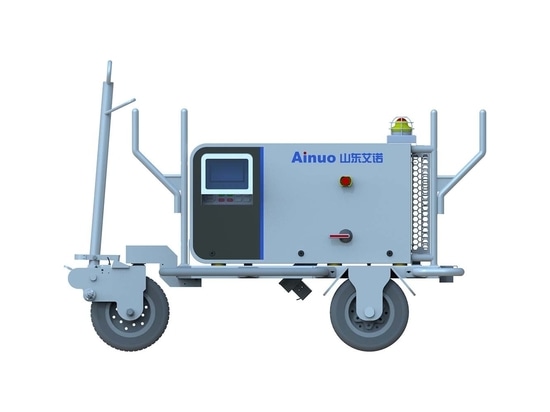
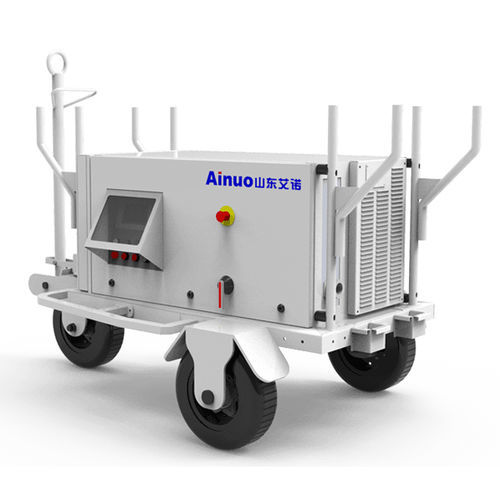
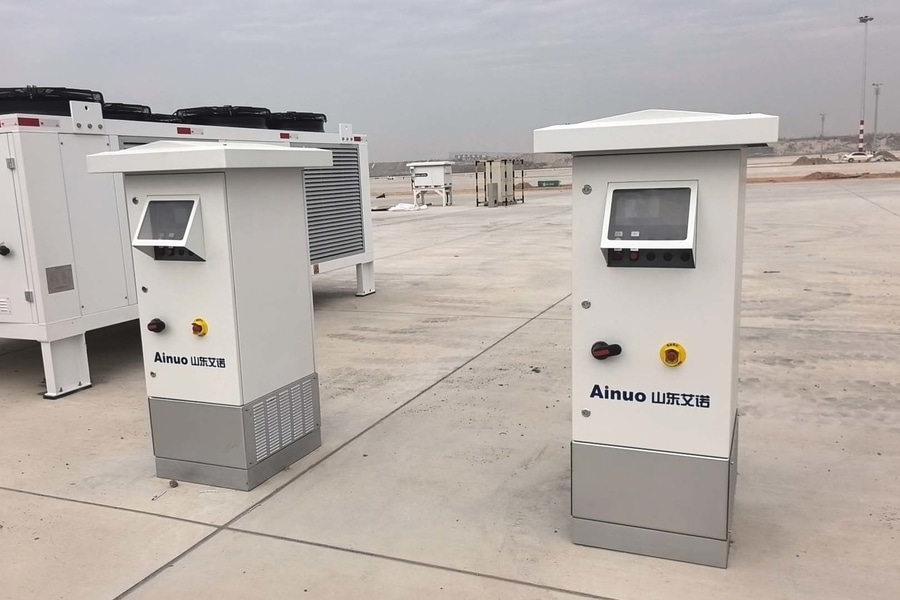
Modern high-efficiency systems, such as the AN17(F) Series, support seamless parallel expansion. Multiple units can be combined to form a high-capacity central supply that distributes power to numerous aircraft stands via distribution cabinets and remote voltage-drop compensators.
Benefits of centralized efficiency:
* Reduced ramp clutter—fewer physical units occupying valuable gate space.
* Optimized energy usage—the system automatically adjusts the number of active modules based on total load, preventing "wasted" idle capacity.
* Simplified maintenance—faulty modules can be isolated and replaced without shutting down power to the entire gate area.
---
Competitive Landscape: Why Buyers Are Demanding More
Major airport tenders are increasingly treating efficiency metrics as non-negotiable requirements rather than "nice-to-haves."
If a 400Hz ground power supply cannot demonstrate a power factor above 0.95 and THD below 5%, it is often disqualified before price comparisons even begin. Manufacturers still relying on analog, low-power-factor designs are finding themselves rapidly outpaced.
The bar has been raised—and it is staying high.
-
Frequently Asked Questions (FAQs)
Q: What is a 400Hz ground power supply used for?
A: It converts standard 50/60Hz utility power into 400Hz AC power required by commercial and military aircraft for ground operations, including maintenance checks, cabin climate control, and avionics testing while the main engines are off.
Q: Why does harmonic distortion matter in ground power equipment?
A: High harmonic distortion feeds back into the airport grid, interfering with other sensitive electronics, increasing heating in cables and transformers, and triggering nuisance tripping of protective devices. Reducing THD to <5% ensures grid stability and lowers energy losses.
Q: How does FPGA digital control improve 400Hz GPU performance?
A: FPGA-based control enables lightning-fast load regulation, extremely clean output waveform synthesis, and intelligent system features like automatic master-slave switching and predictive fault isolation—capabilities impossible with traditional analog circuits.
Q: Can modern high-efficiency GPUs really lower airport electricity bills?
A: Absolutely. By improving the power factor to >0.96, airports eliminate utility penalties for reactive power. Combined with intelligent load-based start/stop functions, these systems can reduce overall energy consumption by 15–25% compared to legacy units.
Q: Are these high-efficiency units suitable for outdoor ramp use?
A: Yes. Modern high-efficiency 400Hz ground power supplies are engineered with robust IP55 weatherproof ratings and wide operating temperature ranges (-40°C to +60°C), making them suitable for harsh outdoor airport environments worldwide.
The Road Ahead: A Smart, Green, and Efficient Tarmac
The evolution of the 400Hz ground power supply reflects a broader shift in aviation: the industry is finally treating ground operations as a critical lever for sustainability and cost savings.
With features like 30% smaller footprints (freeing up precious ramp space), "black box" data logging for predictive maintenance, and seamless IoT integration capabilities, the modern GPU is no longer just a power source—it is a smart asset.
Airport operators and ground handling companies face a clear choice: continue patching up outdated, inefficient equipment and bleed money through energy waste, or embrace the high-efficiency revolution that delivers cleaner power, lower bills, and superior operational reliability.
The future of airport ground power is efficient, intelligent, and digital. Is your operation ready for it?