#Product Trends
Beyond GPU and PCA: Why Complete Ground Support Requires Gas Charging Systems
Some aircraft delays do not begin with a major failure. Sometimes it is something far less dramatic. A strut needs nitrogen. An oxygen system has to be replenished before the next flight.
Some aircraft delays do not begin with a major failure. Sometimes it is something far less dramatic. A strut needs nitrogen. An oxygen system has to be replenished before the next flight. A pneumatic task is waiting for high-pressure air. The aircraft is parked at a remote stand, the maintenance team is ready, the schedule is tight, but the right servicing unit is not where it needs to be.
Airport operators and MRO teams face this situation more often than they should. Modern ground support is often discussed through the big systems: ground power units, fixed 400 Hz infrastructure, 28.5 V DC power, PCA, PIT systems, cable management, battery GSE and electric fleets. All of that matters. But aircraft readiness is not built on electrical power alone.
A complete ground support setup also has to cover the pressure-based services that keep specific aircraft systems ready for operation. Nitrogen. Oxygen. Compressed air. Not the most glamorous side of GSE, perhaps, but when these services are missing, everyone notices.
The real issue is not equipment. It is access.
Equipment is rarely the bottleneck. Most airports and MROs have it. It all comes down to one thing: can the right team get to the right aircraft exactly when it's needed?
A remote stand might have ground power, but that doesn't mean nitrogen or oxygen work can happen there. The hangar could be fully equipped, yet the aircraft needing attention is out on the apron. At regional airports, planes come and go without fixed servicing points everywhere you need them. And in military operations, support has to follow the mission — not some tidy infrastructure plan.
In these situations, having nitrogen, oxygen or compressed air somewhere on site is only part of the picture. What matters in daily operations is whether the service can reach the aircraft quickly enough to keep the work moving.
This is the practical value of aviation gas charging equipment. It brings servicing closer to where the aircraft actually is, instead of forcing the aircraft, the technician or the workflow to adapt around a fixed service point.
Why this matters now
Ground support planning is no longer as straightforward as it once was. Airports are electrifying, but usually step by step. One stand gets upgraded, another waits. PCA and fixed 400 Hz systems are installed where the investment makes sense. Battery GPUs and cleaner mobile GSE are becoming more common too.
But it does not remove the need for gas servicing. Actually, it makes the wider ground support picture more important. If the goal is to reduce unnecessary APU use and rely more on airport-side support, then the airport-side support has to be complete. Power and conditioned air are part of it. So are nitrogen charging, oxygen servicing and high-pressure air support. Otherwise, the operation becomes cleaner in one area but still exposed in another.
Nitrogen servicing: small task, high consequence
Nitrogen is one of those things that can sound ordinary until it is not available.
Aircraft use nitrogen because it is dry, stable and inert. It is commonly used for aircraft tyres, landing gear shock struts, hydraulic accumulators and other systems where pressure stability matters. Moisture, oxygen content and pressure variation are not welcome in these systems.
For an MRO, nitrogen servicing is often tied to workflow. A system needs to be checked, serviced or brought back to the required pressure before the next task can continue. If the nitrogen unit is not available, the team waits. The aircraft waits. And the schedule absorbs the delay, and nobody enjoys that conversation.
Having ground power at a remote stand is a start, but it won't help when nitrogen or oxygen work is needed. The hangar might have everything imaginable, yet the aircraft that actually needs attention is sitting out on the apron. At regional airports, planes move around constantly and servicing points simply cannot follow them everywhere. In the military, it is even less predictable, support has to move with the mission, not with a map that was drawn up in advance.
ElectroAir's EA-NITROGEN Gas Charging Station is designed for high-pressure nitrogen charging of aircraft systems at pressures up to 350 MPa. Truck-mounted and operable by a single trained driver-operator, it deploys fast and folds quickly when time is short. Built to work in temperatures from –40°C to +50°C, it is equally at home at a civil airport, a remote airfield or a military facility.
Oxygen servicing belongs in its own category
Oxygen is different. It should not be treated as just another gas in the same general bucket. Aircraft oxygen systems are linked to crew support, passenger safety, emergency readiness and mission requirements. It is part of the aircraft’s operational readiness.
Here again, the problem is usually not “does the facility have oxygen somewhere?” The better question is: can the aircraft be serviced where it is parked?
Remote stands, MRO aprons, military areas, temporary operating zones and mixed-use airports all create situations where the aircraft is not sitting next to a convenient servicing point. Moving equipment is usually easier than moving the whole operation around one service need.
ElectroAir's EA-OXYGEN Gas Charging Station is built for one specific job: safe, high-pressure medical oxygen charging of onboard aircraft systems, including cylinders and central oxygen systems on commercial and military aircraft. Truck-mounted and deployable across aprons, remote stands and MRO environments, it operates at pressures up to 350 MPa using dry piston booster technology optimised for oxygen applications. A dedicated driver and trained oxygen specialist are required, keeping safety central to every operation.
Compressed air still earns its place
Compressed air does not always get much attention in GSE conversations. It is not as visible as a GPU cable, not as central in electrification discussions as battery equipment, and not as easy to promote as a shiny new power system. Still, it is needed.
Aircraft and helicopters rely on high-pressure air for a wide range of needs, from pneumatic systems and accumulators to onboard equipment, maintenance checks, testing and general ground support. In MRO environments, this often comes down to timing, where the next step simply cannot begin until a system has been serviced or tested. In military settings or remote airfields, the challenge shifts, and the real question becomes whether high-pressure air support can keep up with the aircraft as operations move into less predictable and less forgiving environments.
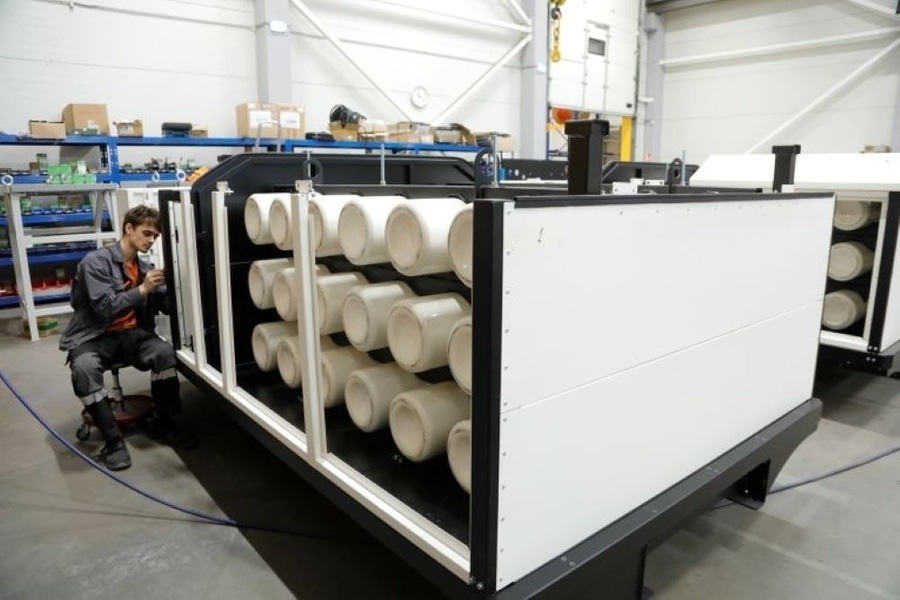
ElectroAir's EA-20-350 Air Servicer Unit delivers high-pressure compressed air across six pressure stages up to 320 kgf/cm², supporting aircraft and helicopter pneumatic systems, accumulators, onboard equipment and maintenance checks. Its 20 seamless 50-litre steel cylinders provide extensive operational capacity and long-term durability. Truck-mounted for fast positioning at any location, it is built for severe climates, high humidity and mission-critical environments. Equally suited to civil aviation, military operators and MRO facilities, it arrives complete with full documentation and spare parts support.
When the stand isn't perfect, mobility fills the gap
For airports, mobile gas charging systems add another layer of resilience.
That word gets used a lot, sometimes too much, but here it fits. Airports do not operate in perfect geometry. Stands are occupied. Remote positions are used. Seasonal peaks happen. Construction phases change traffic flows. Some areas are fully upgraded, others are still catching up. Then come special flights, military movements, cargo operations, VIP aircraft, maintenance activity and all the other things that make airport life interesting, and occasionally inconvenient.
In that environment, fixed infrastructure alone will not cover every case.
Mobile nitrogen, oxygen and compressed air servicing helps airports support aircraft across a wider operating area. It also reduces the need to reposition aircraft just because a servicing task cannot be completed where the aircraft is parked.
For an airport operator, the value is not complicated:
• less dependency on one ideal stand setup;
• better support for remote and mixed-use areas;
• more complete ground support during phased modernization;
• fewer service gaps around APU-off and airport-side support models.
In other words, the airport becomes less fragile operationally.
The MRO problem is workflow, not equipment
MRO teams tend to see this a little differently. For them, it is about workflow. Maintenance tasks follow a sequence, and one check leads naturally to the next. A pressure-related task can surface during an inspection, well outside the original work plan. When nitrogen, oxygen or compressed air support is not close to the aircraft, the delay does not just sit in the background. It lands right in the middle of the maintenance schedule.
That is where mobile aircraft gas servicing equipment earns its place. It brings the service to wherever the aircraft is being worked on, whether inside a hangar, out on the apron, at a remote maintenance area or in a military facility. It also helps cut down on the informal workarounds that maintenance teams know all too well: waiting on shared equipment, reshuffling the task order, moving people from one place to another, or relocating the aircraft simply because the setup was not working.
Where this fits into airport electrification
Airport electrification is often presented as a story about replacing diesel-driven equipment with electric alternatives. That is part of it, but a more useful way to look at electrification is this: the airport is trying to provide more support from the ground, with less reliance on onboard systems and less unnecessary movement around the aircraft. By that definition, gas charging systems belong in the discussion.
They do not compete with electric GPUs, battery GPUs, fixed 400 Hz systems or PCA. They sit beside them. They cover the pressure-based services that remain necessary even as the airport improves electrical infrastructure.
This is especially important during phased modernization. Very few airports upgrade everything at once. One area gets new systems first. Another waits. A remote stand remains remote. A hangar expansion changes the flow. Mobile gas servicing helps bridge those practical gaps while the wider infrastructure plan continues.
ElectroAir supports this broader airport electrification roadmap with a portfolio that covers the main building blocks of modern ground support: 400 Hz and 28.5 V DC power supply, PCA, PIT systems, cable management and aviation gas charging equipment.
Built around the operator’s truck platform
One practical advantage of ElectroAir’s gas charging range is that the equipment can be configured around the truck platform selected by the operator.
Airport, MRO and defence operators often have existing fleet standards, terrain requirements, maintenance routines, procurement rules and climate conditions. A unit that fits the operator’s preferred truck platform is easier to integrate into the real fleet, with fewer compromises.
That is particularly useful for civil airports with mixed stand layouts, MRO facilities with several hangar and apron areas, military airfields with remote or tactical requirements, regional airports with limited fixed infrastructure, and operators working in severe weather or high-humidity environments.
If the unit works with the operator’s fleet logic, it has a better chance of being used properly, maintained properly and placed where it actually helps.
The bottom line
A strong ground support setup is not only about having the largest or most visible equipment on the apron. It is about reducing weak points.
If aircraft power is available but nitrogen servicing is difficult, there is still a gap. If PCA is in place but oxygen servicing depends on extra movement or waiting, the operation is still exposed. If compressed air is needed for a maintenance check and the unit is not near the aircraft, time is lost. That is why gas charging systems deserve a place in ground support planning.