#Industry News
Aircraft Weight reduction
Company News
Reducing aircraft weight is a continuous priority for airlines. One common approach involves optimizing onboard items, including those used in catering and service.
For example, one airline estimated that removing just one pound (0.45 kg) from each aircraft in its fleet could save around 53,000 liters of fuel annually—equivalent to tens of thousands of dollars. Considering that some aircraft burn up to one gallon of fuel per second, and fuel accounts for about 21% of airline operating costs (a figure expected to increase), reducing weight is a straightforward way to improve efficiency.
Some initiatives are more practical than others. Virgin Atlantic, for instance, introduced thinner glassware and removed heavier slate plates from its upper-class service. The airline also switched to lighter chocolate and confectionery options, redesigned meal trays (allowing fewer service carts onboard), and adjusted beverage offerings on night flights when consumption is lower.
Qantas implemented weight-saving measures in preparation for its non-stop Perth–London route. New crockery, glassware, cutlery, and linen reduced onboard weight by 11%. It also decreased the weight of its international service trolleys to 18 kg—a reduction of 7 kg. Once these changes are fully deployed, the airline expects to save approximately 535,000 kg of fuel annually.
British Airways, supported by a dedicated fuel efficiency team, reduced the weight of its catering equipment and switched to lighter paper for its in-flight magazine. United Airlines made a similar change, saving 28 grams per magazine copy and approximately $300,000 per year.
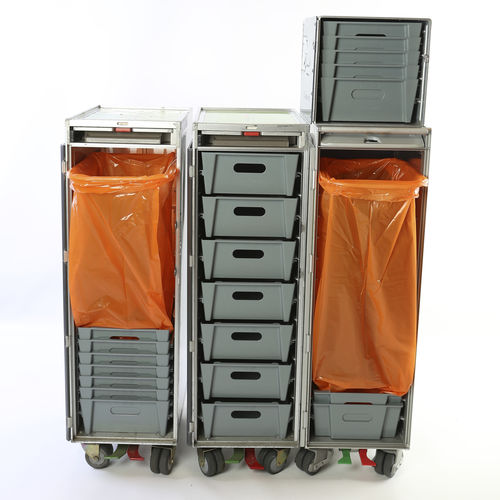
Flex-e-Products supports airlines in their weight reduction strategies. Waste carts typically include bins weighing up to 8 kg, depending on the airline. In collaboration with Korita, Onboardlogistics removed the bin from the trolley and installed a rail system to secure the Flex-e-Bag directly, eliminating unnecessary weight.
Some airlines use separate trolleys for service and waste collection, which is inefficient in a weight-conscious environment. By using Flex-e-Bag and/or Flex-e-Drawer for both service delivery and waste collection, airlines can eliminate the need for additional waste carts—saving around 16 kg per cart.
Beyond weight savings, this approach also frees up valuable galley space, which can be used for revenue-generating activities such as pre-ordered meals or onboard retail sales.