
#Product Trends
The Energy Source for Efficient and Sustainable Aircraft Ground Operations
When the aircraft is on the ground, the energy still needs to flow
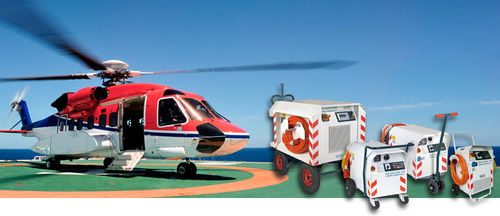
An aircraft is parked at the gate, its engines are switched off – yet a wide range of electrical systems on board continue to operate. Avionics, cockpit systems, lighting, communication, catering equipment, air conditioning and numerous other systems require a reliable supply of electrical power while the aircraft is on the ground.
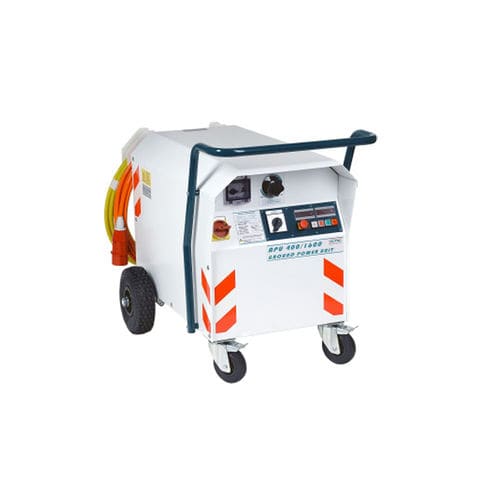
This is where Ground Power Units (GPUs) play a crucial role. Mobile or stationary ground power systems provide external electrical power to the aircraft, allowing the onboard Auxiliary Power Unit (APU) to remain switched off for as long as possible during ground operations.
A GPU is therefore much more than a simple power source. It is an important component of modern ground handling and can contribute directly to operational efficiency, reliability and the reduction of emissions and noise.
Why external ground power matters
An aircraft’s APU is a highly capable onboard power source. Typically located in the tail section, it can provide electrical power and, depending on the aircraft, conditioned air. However, the APU consumes aviation fuel and produces emissions and noise while operating.
Using an external GPU allows aircraft operators to reduce the use of the APU during ground operations. This can lower fuel consumption and local emissions while also reducing noise around the aircraft.
For airports, airlines and ground handling providers, the benefits can become significant when multiplied across thousands of aircraft movements each year.
The right GPU is therefore not simply a matter of available power. The energy source, application, infrastructure and operating profile all have to be considered.
Providing power exactly where it is needed
One of the most important applications for a GPU is during the aircraft turnaround – the period between an aircraft's arrival and its next departure.
While passengers are boarding or leaving the aircraft, baggage and cargo are being handled, cleaning and maintenance work is being carried out and the crew is preparing for the next flight, electrical power is still required on board.
A GPU provides this power externally, allowing the aircraft's APU to remain switched off while the necessary systems continue to operate.
This can provide several advantages:
Reduced fuel consumption
Lower local emissions
Reduced noise on the apron
Reduced operating time of the APU
More efficient ground operations
Improved working conditions around the aircraft
At airports with high numbers of aircraft movements, even relatively short periods of reduced APU operation can add up to substantial savings over the course of a year.
Power quality is just as important as power availability
A Ground Power Unit does not simply have to deliver electricity – it has to provide it reliably and in the correct quality for the aircraft being serviced.
Defined voltage and frequency requirements are essential in aviation. For many commercial aircraft, for example, 115/200 V at 400 Hz is a standard requirement for AC ground power. Depending on the aircraft type and application, DC power solutions are also used.
A reliable GPU therefore requires much more than a powerful generator. Output power, voltage, frequency, regulation, protection functions, connection systems and the interface with the aircraft all have to work together.
A modern Ground Power Unit is a sophisticated electrical system designed to operate reliably under demanding conditions while remaining safe and easy to integrate into daily ground operations.
Sustainability starts on the ground
The aviation industry is facing the challenge of reducing emissions throughout the entire operational chain. While the focus is often placed on the flight itself, the time an aircraft spends on the ground also offers considerable potential for improvement.
Aircraft spend significant amounts of time parked at gates, undergoing maintenance, being loaded and unloaded or prepared for their next flight. During these periods, energy is still required even though the aircraft is not airborne.
This makes the electrification of ground operations increasingly important.
Electric Ground Power Units can play a significant role in this development. When power is supplied from an appropriate electrical infrastructure, local exhaust emissions from the ground power source can be eliminated. At the same time, noise levels and the need for fossil fuels on the apron can be reduced.
The result is a quieter and potentially more sustainable working environment around the aircraft.
Mobile flexibility meets the electric future
Not every airport or operating location has access to fixed ground power at every parking position. This is where mobile Ground Power Units offer a particular advantage.
They can be deployed wherever electrical power is required – in hangars, on the apron, during maintenance operations or at remote parking positions.
For operators, this creates an attractive combination of flexibility and electrification. Instead of relying exclusively on fixed infrastructure, mobile solutions can provide power where and when it is needed.
This can be particularly relevant for General Aviation, Business Aviation, MRO facilities, flight schools and smaller airports, where operational flexibility is often just as important as efficiency.
The GPU as part of a larger system
The future of ground power will not be defined by the GPU alone. Instead, Ground Power Units are becoming part of a wider ecosystem of increasingly electrified airport operations.
Other technologies, including Pre-Conditioned Air (PCA), electric Ground Support Equipment (GSE), charging infrastructure and intelligent energy management systems, are becoming increasingly important.
The objective is clear: aircraft should be supplied as efficiently as possible during their time on the ground, without unnecessary operation of their engines or onboard auxiliary systems.
The GPU therefore acts as an important link between the airport's electrical infrastructure and the aircraft.
Engineering experience for demanding aviation applications
For manufacturers and operators, this development means that Ground Power Units increasingly need to be tailored to specific aircraft, operating environments and customer requirements.
RECK SOLAR & ELME ELEKTROMECHANIK combine expertise in electrical engineering and electromechanical solutions to develop and manufacture reliable systems for demanding applications.
The objective is not simply to provide sufficient power. A successful ground power solution must be reliable in everyday operation, intuitive to use and precisely matched to the requirements of the aircraft and its operating environment.
Because on the apron, one thing matters above all:
The power supply has to work – safely, reliably and whenever it is needed.
Ground Power Units will become increasingly important
The importance of Ground Power Units is set to grow in the coming years. The increasing electrification of ground handling, stricter requirements regarding emissions and noise, and the need for more efficient turnaround processes all support the wider adoption of external aircraft power.
Ground Power Units are a good example of how innovation in aviation does not only happen in the air. Modern technology on the ground can have a direct impact on how efficiently, quietly and sustainably an aircraft is operated.
When an aircraft is on the ground, the next operation has already begun. A reliable Ground Power Unit ensures that the right energy is available exactly where it is needed.