#Product Trends
Pricing Strategies in the Ground Power Unit Market – Between Cost Pressure, Electrification, and Service-Based Models
Efficency
The pricing dynamics in the Ground Power Unit (GPU) market are currently undergoing a noticeable transformation. Only a few years ago, purchasing decisions were often driven primarily by acquisition costs. Today, however, the market is increasingly shaped by more complex factors: rising sustainability requirements, new technologies, energy costs, digitalization, and changing operator strategies. For airports, ground handlers, and MROs, a different question is becoming more relevant: What is the cost not of the GPU itself, but of its operation throughout its entire lifecycle?
The global GPU market continues to grow steadily. Key drivers of this development include the recovery of air traffic, investments in modern airport infrastructure, and increasing demand for low-emission ground support solutions. Market analyses project annual growth rates of approximately six to seven percent through the 2030s.
From Product Price to Total Cost of Ownership
The traditional pricing logic of “higher performance = higher price” is increasingly losing relevance. Instead, operators are focusing more on the concept of Total Cost of Ownership (TCO), meaning the overall cost throughout the entire product lifecycle.
Key factors include:
Energy consumption
Maintenance costs
Spare parts availability
Operating hours
Service life
Downtime
Emissions and noise-related costs
Electric and battery-powered GPUs often involve higher upfront investment costs; however, they can become more cost-effective over time due to lower operating and maintenance expenses. At the same time, conventional diesel-powered systems are becoming less accepted at many airports.
Electrification is Changing Pricing Structures
The electrification of airport aprons is not only changing the technology itself but also reshaping manufacturers’ pricing strategies. While mobile GPUs still dominate the market, demand for electric and hybrid solutions continues to increase.
Another important factor is often underestimated: in daily flight operations, the lowest purchase price does not automatically represent the most economical solution.
Practical experience shows that reliability plays a critical role. Older mobile systems in particular can disrupt operations through voltage interruptions or technical failures, potentially causing delays. In contrast, modern fixed-installed systems are frequently regarded as more stable and reliable.
For operators, this means that a low purchase price can quickly be offset by unexpected failures and additional operational costs.
Maintenance as an Economic Factor
Against this background, regular maintenance of Ground Power Units is becoming increasingly important. In particular, annual recurring inspections contribute significantly to ensuring operational safety, availability, and the long-term durability of the equipment.
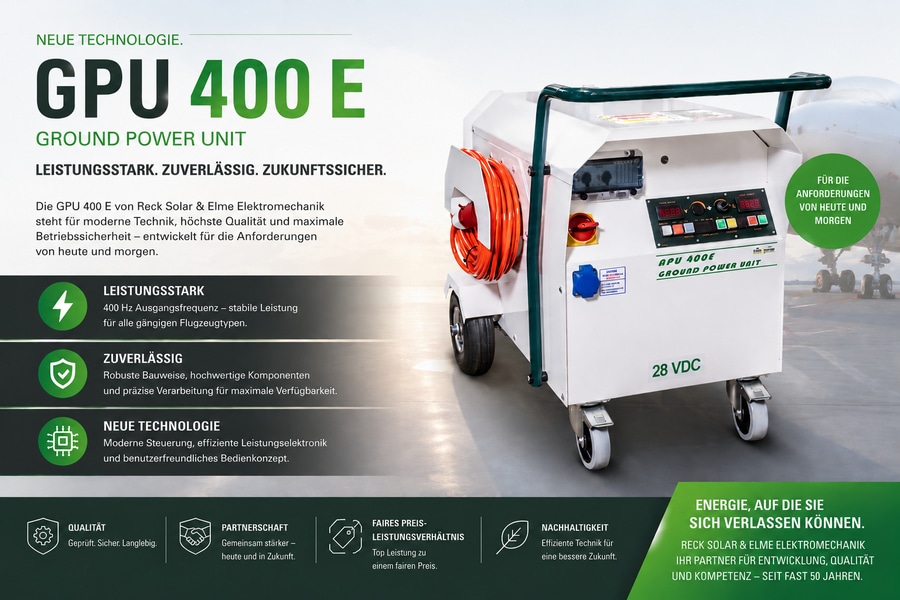
Companies such as Reck Solar and ELME Elektromechanik provide corresponding inspection and maintenance services, performing comprehensive assessments of GPUs in terms of functionality, safety, and performance.
Conclusion
The GPU market is increasingly evolving from a purely product-centered approach toward a service- and usage-oriented pricing model. For airports and ground handlers, this means that the question “What does the GPU cost?” is increasingly being replaced by another: “What does aircraft power supply cost over the entire period of operation?”
Within an environment shaped by electrification, sustainability targets, and growing cost pressure, this development is expected to significantly influence market strategies in the years ahead.
With nearly 50 years of experience, companies such as Reck Solar and ELME Elektromechanik are actively supporting this transition by focusing on durable solutions, high reliability, and long-term partnerships.
Core values that remain in focus:
Quality
Reliability
Attractive price-performance ratio
Durability
Partnership-based collaboration