
#Industry News
Why APAC is redefining aviation’s growth landscape
Global aviation growth is fragmenting, and APAC is redefining where it will be delivered.
While mature aviation markets continue to recover despite the weight of supply-chain constraints and rising costs, a different story is unfolding elsewhere.
In Asia-Pacific (APAC), demand is accelerating, and this is reshaping where capacity, investment, and innovation will be concentrated throughout the next decade.
For airlines, MROs, and OEMs, this shift is more than geographic. It signals a structural rebalancing of where aviation value will be created, and how it must be delivered. The implication is clear: growth is no longer just about demand, it is about the ability to deliver against that demand.
The shift towards APAC is not cyclical. It reflects a long-term rebalancing of where demand, fleet expansion, and aftermarket growth will be concentrated over the next two decades.
Explore the full 2026 Satair Industry Report to see how these structural shifts are reshaping aviation growth, supply chains, and operational strategies.
Demand is shifting and so is the centre of aviation activity
China and India sit at the heart of this accelerating transformation in APAC. Together, they are adding millions of new middle-class consumers each year, fuelling demand for both domestic and international travel.
While China and India remain the primary growth epicentres, the momentum extends across the wider region.
Southeast Asia is emerging as a network of high-growth aviation ecosystems, where rising incomes, urbanisation, and digital adoption are accelerating air travel demand at scale.
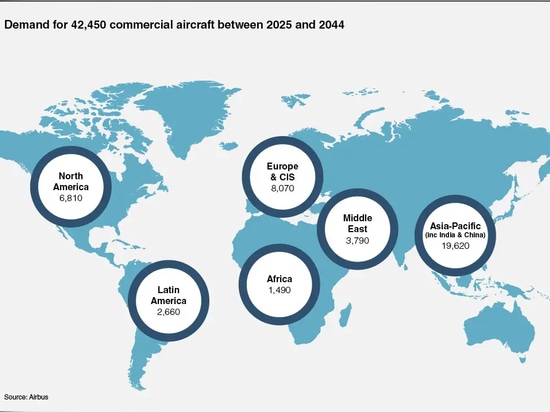
This momentum is reflected in long-term fleet projections. Over the next two decades, Asia-Pacific is expected to account for nearly half of global aircraft demand by 2044, with close to 20,000 new aircraft deliveries, significantly outpacing every other region and cementing APAC as the dominant driver of fleet expansion.
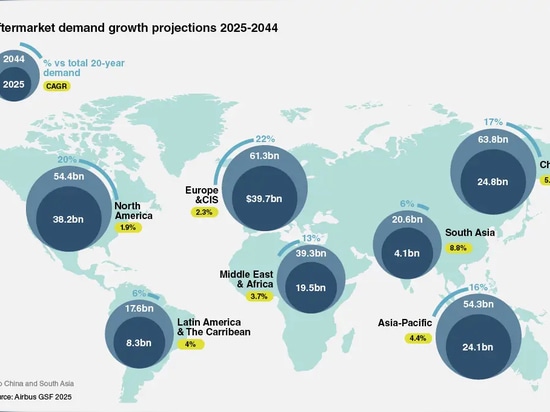
Fleet growth is only part of the equation; as aircraft numbers increase, so too does the long-term demand for maintenance, components, and material support. The aftermarket will scale in parallel with fleet expansion, placing sustained pressure on supply chains, inventory availability, and regional MRO capacity.
Across APAC, this means not only more aircraft in operation, but a faster-growing requirement for parts, repairs, and services to keep those fleets flying. Aftermarket demand is expected to rise significantly across the region, reinforcing APAC’s position not just as the centre of fleet growth, but as a key driver of global maintenance demand.
Scaling under pressure: growth meets constraint
APAC’s growth trajectory does not come without challenges.
The same structural constraints affecting global aviation, including parts shortages, labour gaps, and delayed aircraft deliveries, are present in the APAC region. In fact, they are amplified by the pace of expansion.
High utilisation rates increase maintenance frequency. New-generation aircraft introduce more complex repair requirements. Limited local MRO capacity can create bottlenecks if not scaled in parallel with fleet growth.
This creates a defining paradox: the fastest-growing market is also the most exposed to supply-chain friction.
As a result, success in APAC will not be defined by access to demand alone, but by the ability to operationalise it reliably, predictably, and at scale.
The strategic imperative: proximity to growth
For global players, the implications are significant. Capturing growth in APAC requires operational proximity, ensuring that supply chains and services are positioned close to demand and not exposed to unnecessary friction.
Positioning inventory, partnerships, and capabilities closer to where demand is accelerating will be critical to capturing opportunity. In practice, this means:
Expanding regional MRO hubs to increase local capacity and reduce turnaround times
Scaling component pools and rotable inventory to support high-utilisation fleets
Investing in freighter conversions and cargo support, as e-commerce demand accelerates across the region
More broadly, aligning supply-chain networks with high-growth corridors strengthens responsiveness, while deeper partnerships enable local agility combined with global coordination.
In a market where delays are costly and utilisation is high, distance is not just a logistical factor – it can become a competitive disadvantage.